LRA Research · The human-situation system around the model

AI that understands people as humans.

LRA builds the human-situation system around the model. From permitted evidence, it maintains the user, relevant people, relationships, roles and authority, objectives, pressures, constraints, commitments, prior interventions, and changing state.

Before the model writes, LRA determines what the interaction should try to accomplish and what move fits. Afterward, it records how the move landed and governs what should update.

The model supplies intelligence and language. LRA maintains the human situation, selects the move, and learns from what happens next.

The user retains the objective and decision.

ONE LRA PRODUCT IN ACTION

Sales Trajectory

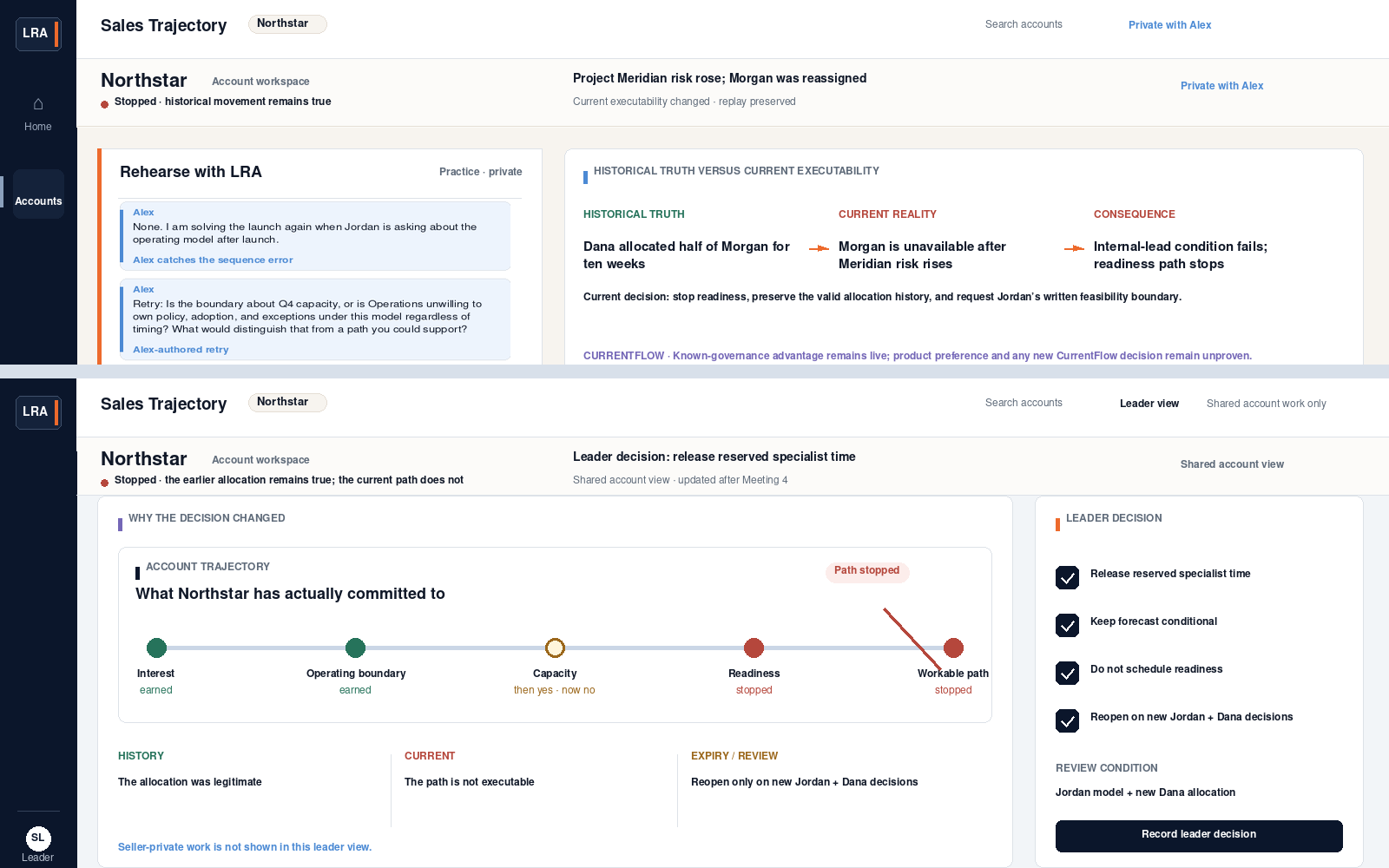
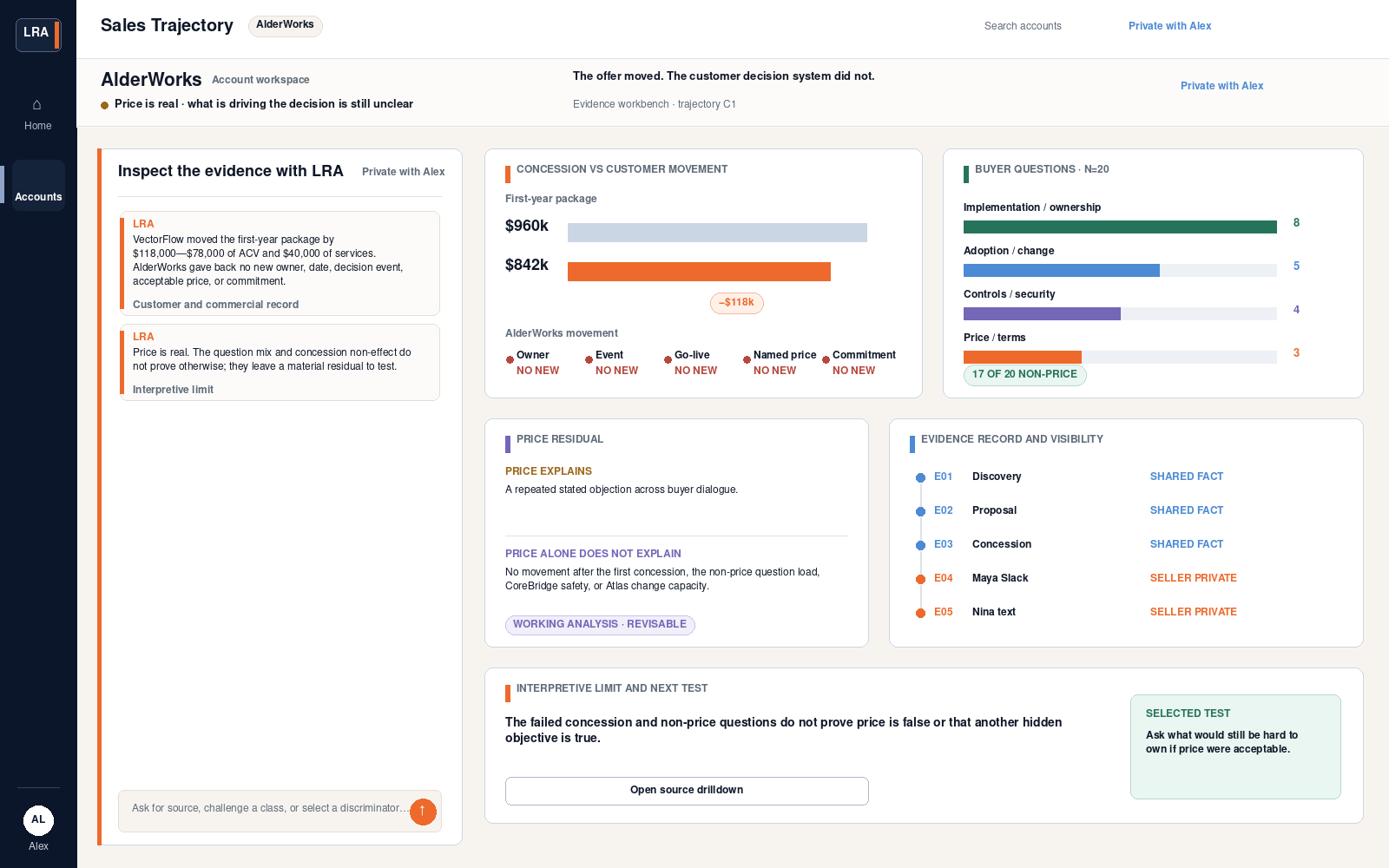
To make the system concrete, this page follows one worked product example. Sales Trajectory applies the common LRA core to a revenue account: maintaining the customer relationship, selecting the next legitimate interaction, and developing the seller through the work. It is one expression of LRA — not the definition or boundary of the company.

The deal behind the meetings

Illustrative synthetic demonstration · Fictional companies and participantsAudited and manually orchestrated · Not production software or an external customer result

Alex leaves the first customer meeting believing the deal has moved. The sponsor wants a Q4 result. The Operations leader has asked for a proposal. But the decisive customer reality is still unresolved: who will own the work, who can allocate the required capacity, and what evidence must exist before anyone can authorize a pilot.

The transcript says: send the proposal. The relationship says: learn what the customer can genuinely own.

VectorFlow
- provider
Northstar
- customer
Alex
- seller
Riley
- executive sponsor
Jordan
- Operations leader
Dana
- capacity authority
Priya
- security authority
Morgan
- proposed internal lead
What Alex sees next

LRA Relationship Brief

for the illustrative VectorFlow and Northstar case
LRA Relationship Brief for the illustrative VectorFlow and Northstar case
What the evidence supportsProduct interest, Riley's sponsorship, urgency for a Q4 result, and permission to send a proposal.
What remains unearnedOperations ownership, internal capacity, security approval, pilot authorization, and any commercial commitment.
Who holds the relevant authorityJordan sets the Operations boundary. Dana allocates capacity. Priya retains security authority. Riley can sponsor and request; she cannot decide for them.
The next sceneA Jordan-led ownership review - before an executive approval meeting or polished proposal presentation.
What that scene must accomplishLet Jordan define whether any workable customer-owned path exists, what evidence it requires, and what event would produce a decision.
Seller coaching focusReceive the customer's boundary before solving around it. Do not convert ambiguity into forward motion.
What the evidence supports
Product interest, Riley's sponsorship, urgency for a Q4 result, and permission to send a proposal.
What remains unearned
Operations ownership, internal capacity, security approval, pilot authorization, and any commercial commitment.
Who holds the relevant authority
Jordan sets the Operations boundary. Dana allocates capacity. Priya retains security authority. Riley can sponsor and request; she cannot decide for them.
The next scene
A Jordan-led ownership review - before an executive approval meeting or polished proposal presentation.
What that scene must accomplish
Let Jordan define whether any workable customer-owned path exists, what evidence it requires, and what event would produce a decision.
Seller coaching focus
Receive the customer's boundary before solving around it. Do not convert ambiguity into forward motion.

LRA does not merely summarize the meeting. It determines what human interaction can usefully happen next.

Find the real path sooner. Reduce false progression and wasted meetings. Engage the people who can move the decision. Develop sellers through the work.

One account. Three moments the meeting record misses.

Sales Trajectory maintains the relationship state across meetings, develops the seller inside the work, selects the next legitimate scene, and changes the strategy when reality changes.

FROM THE PRODUCT EXAMPLE TO THE COMMON CORE

Sales Trajectory is one expression of LRA.

The system below is the common human-situation core that makes this product possible — and can support other products and consequential environments without turning LRA into a sales-only tool.

The system under the experience

A maintained human situation — not a better prompt.

  1. 01

    Maintain the Human World

    Permitted evidence becomes traceable signals. LRA fits a compact reasoning signature and maintains the user, relevant people, relationships, authority, objectives, pressures, constraints, commitments, prior interventions, feasible paths, changing state, and uncertainty.

  2. 02

    Form the scene strategy

    Before language is generated, LRA determines what the interaction should try to accomplish; the move, posture, timing, directness, and reasoning depth; what to emphasize or avoid; and what would trigger revision. The client’s model then writes in its own voice.

  3. 03

    Learn from what happens

    LRA records what it believed, chose, rejected, and expected; observes what happened next; and governs what may legitimately update future understanding or policy.

These are maintained, correctable system objects — not a checklist reconstructed inside each prompt.

The response is not the product. It is one move inside a changing human situation.

CAPABILITY PLANES

One core. Two forms of human-situation intelligence.

Sales Trajectory brings both together inside a revenue workflow: it maintains the account relationship while developing the seller through the work.

01

Customer Relationship Intelligence

Understand why a customer relationship is changing, how the relevant people may be seeing it differently, who has authority, what remains unearned, and which interaction is most likely to restore, protect, or advance customer value.

Product strategy and target experience · Not a production deployment or external customer result

02

Performance Intelligence

Use the longitudinal record of real work to help a professional prepare, interpret what materially happened, test new behavior, and improve judgment and relationship capability across consequential interactions.

Controlled internal demonstration · Person-specific support trajectory · Not a complete multi-person Human World run

HOW THE CORE IS DEPLOYED

Embedded Human-AI

LRA can sit beneath a client’s existing AI product. The client keeps its domain intelligence, model, workflow, interface, voice, brand, policies, and customer relationship. LRA provides compact, partner-safe human-situation and scene-strategy guidance before the client’s model responds.

Memory answers what happened before. Human understanding asks what that history means for this person, in this state, in this situation, now.

Product strategy and controlled integration path · External product impact not yet validated

The LRA Platform

One human core across a client’s approved products.

01

Purpose-bound shared understanding

The same governed human-understanding capability can support approved products and workflows inside a client. Each use remains permissioned and scoped. The Platform does not create one universal profile across products, clients, or companies.

02

Continuity by permission

A user-controlled Human Key is a product direction for carrying relevant, correctable context across a client’s approved products. The user would control access, correction, and revocation. This is not a deployed universal identity system.

Current access: diagnostics · design partnerships · shadow evaluations · bounded integrations · controlled pilots

Underneath are three connected engines for reasoning, interaction strategy, and evidence and learning.

The science

A compact geometry for human reasoning and behavioral dynamics.

LRA’s dynamic reasoning shape compresses observed human behavior and interaction evidence into a geometric representation. It uses a relatively small, bounded set of parameters inside a dynamic, nonlinear, recursive state system so that recurring reasoning patterns, active state, state-change dynamics, directional movement, and behavioral expression become legible enough to inspect, update, and reason over.

Within that shared geometry, each person has a unique Human Signature: the person-specific parameter configuration that represents how they tend to reason, respond to pressure, move among states, and behave under different conditions.

The shared geometry carries the system. The Human Signature supplies the person-specific fit.
A shared dynamic geometry contains recurring states, constrained paths, transition resistance, pressures, and uncertainty. A person-specific Human Signature fits bounded parameters with confidence. The fitted person and live directional state feed the Human World and scene strategy. Observed effects return through governed updating of the fit.
01

Shared dynamic geometry

Constrained state-and-movement system

  • attractor regions
  • feasible · fragile · blocked paths
  • transition resistance
  • pressure + constraint effects
  • uncertainty
  • nonlinear movement
02

Person-specific Human Signature

Bounded fitted parameters + confidence

Schematic parameter fit · confidence / uncertainty

fit marker · parameter-specific confidence interval

Common geometry · person-specific parameter configuration

03

Live state and directional movement

State estimation with alternatives left open

  • current estimated state
  • plausible adjacent states
  • directional movement
  • active pressure or constraint
  • confidence + alternatives
Loop

Closed learning loop

Observed effect revises only what the evidence supports

  1. Fitted person
    + live state
  2. Human World
  3. Scene strategy
  4. Observed effect
Governed updating of the fit
01

Dynamic reasoning shape

The shape is LRA’s shared geometric representation of human reasoning as a state-and-movement system. It represents recurring states, attractors, pressures, constraints, feasible and blocked paths, transition resistance, uncertainty, and movement over time.

It is an effective mathematical model for reasoning over observed human dynamics — not a static profile and not a literal map of a mind.

02

SparseGeometry and the Human Signature

SparseGeometry takes limited, confidence-aware evidence and progressively fits a person’s unique Human Signature to the shape’s bounded parameter set.

Because the geometry constrains the problem, a relatively small number of well-supported parameter fits can unlock a much deeper person-specific understanding of how the individual tends to reason, respond to pressure, move among states, and behave — while also estimating current state, directional movement, alternatives, and uncertainty.

Unsupported dimensions remain provisional rather than being filled with invented certainty.

03

Human World and interaction dynamics

LRA combines the user’s Human Signature and live state with evidence-bound representations of other relevant people, relationships, objectives, authority, pressures, constraints, and mutual effects.

It can then reason about how one person’s movement may change another person’s available paths, form the next scene strategy, observe what happened, and govern what should update.

The model receives a smaller, structured, constraint-bearing human problem — not a larger pile of context.

EVIDENCE AND CURRENT STAGE

Rigorous science. Rigorous internal testing. External validation beginning.

LRA’s core representations, state-and-movement mechanics, evidence rules, interaction logic, and update discipline were developed through a sustained scientific research program.

The resulting fitting systems, simulations, reasoning and interaction engines, and product outputs have been tested extensively across controlled comparisons, multi-case evaluations, multi-turn demonstrations, mechanism checks, negative findings, and preserved run artifacts.

That work supports a technically real, behaviorally differentiated, and mechanistically inspectable system. We are now expanding into controlled external testing with outside users, design partners, and strong baselines.

01

Scientific foundation

The dynamic reasoning shape, SparseGeometry, state-and-movement mechanics, constraint logic, uncertainty boundaries, interaction policy, and governed update rules were developed and specified through a rigorous research program.

02

Rigorous internal system and output testing

LRA’s fitting systems, simulations, reasoning and interaction engines, and visible outputs have been exercised across controlled comparisons, broader decision evaluations, multi-turn demonstrations, mechanism tests, falsification work, and preserved evidence artifacts.

03

External validation beginning

Design partnerships, controlled pilots, and outside evaluations will now test reliability, incremental value, integration burden, production performance, real-world outcomes, and willingness to pay against strong existing baselines.

What the internal evidence supports: a technically real, behaviorally differentiated, and mechanistically inspectable system.

What external testing must now establish: generalized reliability, real-world outcome lift, production economics, repeatable delivery, and commercial willingness to pay.

LRA Research

LRA Research builds the human-situation system around the model.

LRA Research is a product-development and research company building the reasoning, interaction, evidence, and learning systems that help AI understand people and relationships, choose the right human move, and improve from how that move lands.

Making human behavior legible while preserving human agency.

We are opening a limited number of design-partner, external-evaluation, research, strategic, investment, and senior company-building conversations.