Skip to content
LRA Research Legible Reasoning Architecture
Menu

How LRA works

Before the model writes, LRA works out what would actually help.

LRA understands the people, chooses the support, briefs the model, and learns from the result. Your product stays yours.

One application of the shared system

Alex is rehearsing for a customer conversation with Northstar. He offers a smaller rollout and extra support. Jordan, Northstar’s Operations lead, has not settled what her team could own.

He is solving the launch. Is she worried about what follows?

Illustrative LRA sales rehearsal with a simulated Alex. Simplified outputs and dialogue.

Isn’t this a good model with memory?

A good model can give a good answer. LRA combines explicit reasoning models, structured computation, and model inference to preserve understanding, form strategy, and learn across interactions.

What happens outside the final model call?

LRA develops insights into how the user and others in their world are reasoning and what that means for the situation. It forms a support strategy and a response strategy, selects the relevant context, and gives the LLM a focused problem to solve.

The understanding persists. These functions work together on each reply.

Understand the people

Model the reasoning beneath behavior.

A shared model of reasoning drivers becomes person-specific through Human Signature. The fit develops through progressive tightening where it can.

Reasoning Shape

Shared model
Human Signature applied
Fitted to Alex
Alex’s Human Signature attributes make the general human Reasoning Shape Alex’s Reasoning Shape.

Working human insights

Alex
Pressure to show progress can narrow his attention to quick fixes.
Jordan
Less launch work may not resolve ongoing responsibility.
Opportunity
A concrete question can help Alex reconsider.

Human World Every relevant person is treated as a distinct reasoner, not background context.

Inspection follows role and permission. Alex’s private rehearsal is not a manager’s performance report.

Evidence and correction

Jordan, Meeting 1: “What would Operations actually own?”

Alex, Meeting 1: He offered templates and services to address implementation work.

Alex, first rehearsal: He proposed a smaller rollout and more vendor help before establishing what Jordan could own.

Correction: Alex challenged LRA’s initial negative reading. LRA revised it to “unresolved, not negative.” Jordan had requested responsibilities in writing and permitted a proposal.

How the person-specific model works

Reasoning Shape represents recurring, nonlinear and recursive patterns in human reasoning and how choices can change with circumstances.

Human Signature is the set of person-specific factors that make the general Reasoning Shape a person’s Reasoning Shape. LRA collects evidence and patterns to tighten the fit where possible, and leave more open where not.

Human World represents the collection of relevant humans who are treated as separate reasoners with independent reasoning approaches and objectives.

Form the strategy

Form and record the strategy before the words.

LRA combines Alex’s own goal, the human insights, and the situation to decide where support will help most.

Support strategy

Longer objective
Find a workable path with Northstar.
This conversation
Understand what Operations could own.

Response strategy

This reply
Help Alex test his assumption.
Keep
His directness and ownership of the next question.
Avoid
Another ready-made solution.
Watch
Does he explore before proposing?
Planning beyond this reply

The support strategy outlines a near and longer-term approach to help better realize the user’s objectives. The response strategy decides what this particular reply should accomplish. LRA calls an active episode a Scene and the longer path a Trajectory. The longer view informs the next move without replacing the obligation to help now.

Select the context

Preserve understanding. Select what belongs.

LRA preserves records, insights, and the evidence linking them.

Context Selection & Activation (CSA) adds only relevant, permitted information the LLM still needs for realization and voicing.

  1. Memory
  2. CSA
  3. Selected context

Selected for this reply

  • Jordan asked what Operations would own.
  • Alex answered with templates and services.
  • Permission to propose did not settle ownership.
  • The earlier reading was corrected: unresolved, not negative.

Memory informs the whole process. Here, selection focuses the final brief.

Why these four?

Jordan’s question — customer statement: Identifies the ownership issue Alex still needs to explore.

Alex’s answer — seller response: Shows the launch help he already offered.

Proposal permission — working interpretation: Keeps the opportunity open without treating interest as agreement on ongoing responsibility.

Alex’s correction — revised interpretation: Prevents the earlier negative reading from governing the next reply.

Memory preserves the record and the understanding developed from it, with the evidence connecting them. Selection considers what this task needs and may use, including what is already available to the model. A correction can change the current read without erasing its history.

Brief the model

Give the model a formed problem.

The model works on the remaining problem rather than reconstructing the whole human situation.

LRA supplies

  • Human insights
  • Response strategy
  • Selected context
  • Reasoning focus

The model contributes

  • Knowledge
  • Reasoning
  • Language
  • Tools and partner voice

Focused briefHelp Alex test whether launch support resolves ongoing ownership.

Delivery route

LRA forms the strategy and writes the final response.

Illustrative replyWhat did Jordan say that makes a smaller rollout the answer?

Inside the brief

The human insight is that Alex can move toward quick solutions under pressure. The strategy is to help him examine the assumption without taking over his next question. The context is the four items above. The remaining reasoning problem is which question will test whether launch support addresses ongoing ownership.

This is a simplified brief, not the literal package format. The model still contributes its own knowledge, reasoning, and language; tool use and product voice follow the integration.

Models can contribute throughout LRA’s reasoning process, including before the final model call.

Learn from the result

Learn from how the help lands.

LRA records the move and expected effect, compares them with the response and what follows, then refines its support.

In the rehearsal

Expected
Alex examines the assumption.
Observed
“I was solutioning ahead of the buyer again.”
Next
Retry in his own words. Explore responsibility before offering a solution.

The next move can change now. Durable understanding changes as evidence accumulates.

See the retry and learning

Alex’s retry in the source rehearsal: “Is that boundary about Q4 capacity, or is Operations unwilling to own ongoing administration and unresolved exceptions under this model regardless of timing?”

Alex now explores the constraint before offering another solution. The rehearsal changes his preparation; the customer still supplies the answer.

A poor result may point to a mistaken interpretation, an unsuitable strategy, or a delivery mismatch. LRA can adjust the next move, revise the situation, or retain the observation for later learning. One exchange does not automatically rewrite a person’s durable model.

LRA Developer Toolkit

Fits the AI product you already have.

  1. LRA Core
  2. LRA Developer Toolkit
  3. Partner AI Product
You send
Permitted context and a request.
LRA returns
A response, model guidance, an assessment, or role-play.
You keep
Your model, interface, workflow, voice, brand, and customer relationship.
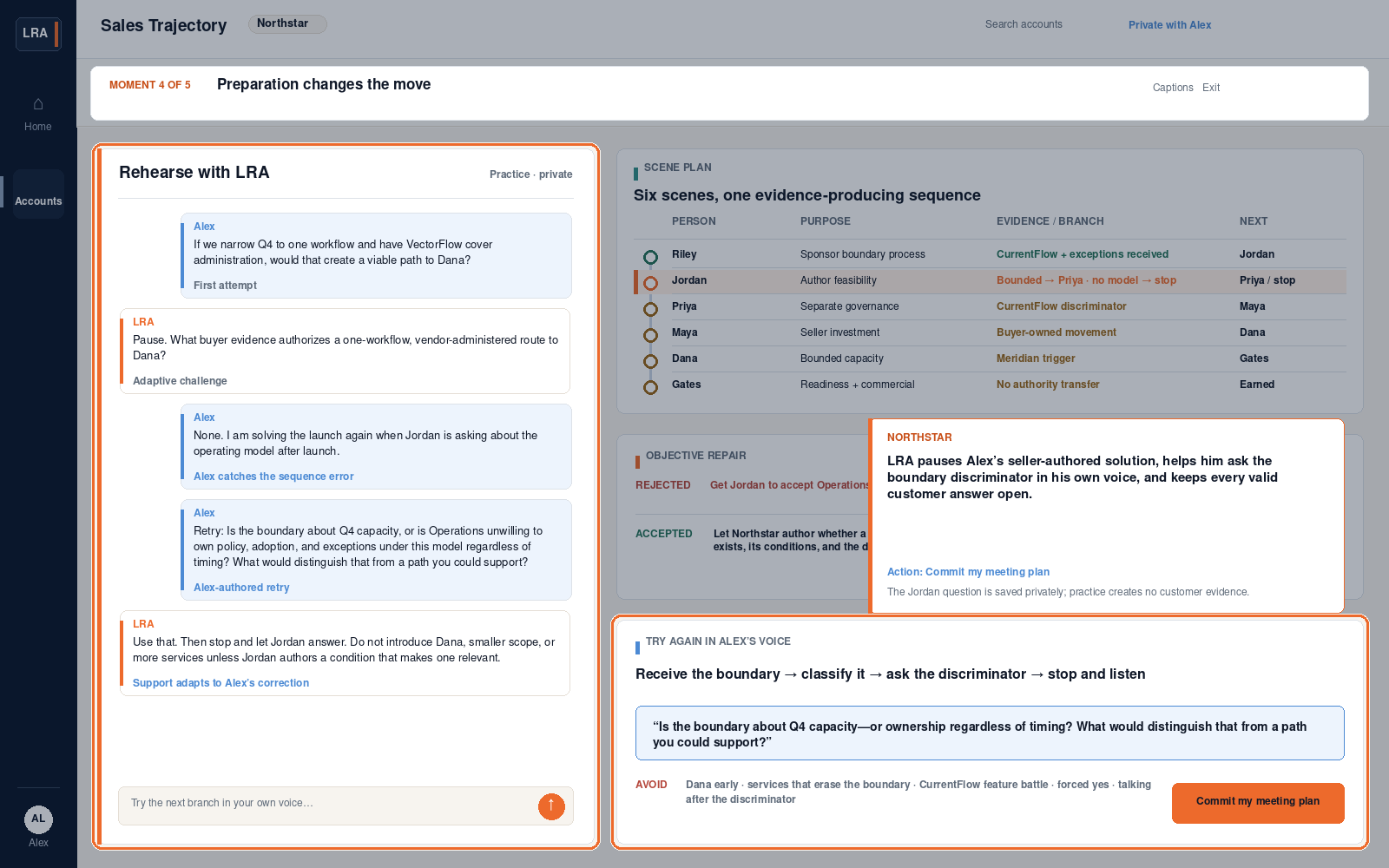
Sales Trajectory rehearsal in Alex’s private workspace, showing his first attempt and LRA’s pause

Sales Trajectory · LRA applied

The application behind Alex’s example.

Discuss an application

Tell us what human problem or workflow you’d like to explore. The form prepares a draft in your email app.

You can also email LRA Research directly.